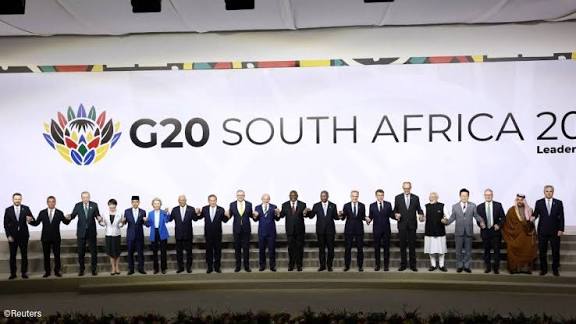








The 2025 G20 Johannesburg summit is the upcoming twentieth meeting of the Group of Twenty (G20), a meeting of heads of state and government planned from 22 to 23 November 2025. It will be the first G20 summit held in Johannesburg, South Africa and on the African continent.
South Africa assumed the G20 presidency from 1 December 2024 to November 2025, approximately five years ahead of the United Nations (UN) Agenda 2030 deadline.
There are high expectations that South Africa will lead a progressive, people-centred, development-oriented and solution-oriented presidency, in a fractured global geopolitical context, until it hands over the presidency to the United States on 1 December 2025.
South Africa’s participation in the G20 is guided by its four strategic foreign policy pillars (national interests, the African Agenda, South-South Cooperation and Multilateralism).
Summit topic
For the G20 to make a meaningful contribution in addressing the polycrisis confronting the world, South Africa has adopted the theme “Solidarity, Equality, Sustainability”.
This theme reflects South Africa’s intention to build on the efforts and successes of the last three G20 Presidencies of the Global South and to advance the development agenda.
Through solidarity, South Africa seeks to achieve a people-centred, development-oriented and inclusive future. In an interconnected world, the challenges facing one nation affect all nations. By promoting equality, the country seeks to ensure fair treatment, opportunities and progress for all people and nations, regardless of their economic status, gender, race, geographic location or other characteristics. Sustainability is about meeting the needs of the present without compromising the ability of future generations to meet their own.
Agenda priorities
South Africa will continue to use the G20 as a premier forum for economic and financial cooperation, bringing together developed and developing countries, and emerging markets to find solutions to global challenges. During the 2024 State of the Nation Address, President Cyril Ramaphosa stated that “we will put Africa’s development at the top of the agenda when we host the G20 in 2025.”
South Africa will use its G20 Presidency to advocate and mobilise support for developing economies in Africa and the Global South, building on the efforts and successes of the Indonesian, Indian and Brazilian Presidencies to champion the development agenda. South Africa will also be using its presidency to promote global debt reform.
The South African G20 Presidency will drive the following high-level outcomes and priorities, which will be expressed in the work of two “tracks”, the Sherpa and Finance tracks:
High-level priorities
- Priority 1 – Inclusive economic growth, industrialisation, employment and reducing inequality
- Priority 2 – Food security
- Priority 3 – Artificial intelligence and innovation for sustainable development
Preparations
The South African government has budgeted R691 million (38.7 million USD) in preparation for the G20 events.
Participating leaders
- Argentina
Pablo Quirno, Minister of Foreign Affairs, International Trade and Worship - Australia
Anthony Albanese, Prime Minister - Brazil
Luiz Inácio Lula da Silva, President - Canada
Mark Carney, Prime Minister - China
Li Qiang, Premier - France
Emmanuel Macron, President - Germany
Friedrich Merz, Chancellor - India
Narendra Modi, Prime Minister - Indonesia
Prabowo Subianto, President - Italy
Giorgia Meloni, Prime Minister - Japan
Sanae Takaichi, Prime Minister - Mexico
Juan Ramón de la Fuente, Secretary of Foreign Affairs - Russia
Sergey Lavrov, Foreign Minister[b] - Saudi Arabia
Mohammed bin Salman, Crown Prince and Prime Minister - South Africa
Cyril Ramaphosa, President (Host) - South Korea
Lee Jae Myung, President - Turkey
Recep Tayyip Erdoğan, President - United Kingdom
Keir Starmer, Prime Minister - European Union
Ursula von der Leyen, President of the European Commission - European Union
Antonio Costa, President of the European Council - African Union
Angola
João Lourenço, Chairperson and President

Notable non-participation
United States president Donald Trump stated the country would not send any representation to the summit, citing claims of Afrikaner persecution in South Africa and calling the hosting of the summit there “a total disgrace”. Argentina’s president Javier Milei withdrew from the summit to support Trump’s boycott, Foreign Minister Pablo Quirno was designed as his substitute.
Invited guests
The following country leaders have been invited to the summit:
- Denmark
Mette Frederiksen, Prime Minister - Egypt
Abdel Fattah el-Sisi, President
2025 chairperson of the New Partnership for Africa’s Development - Finland
Petteri Orpo, Prime Minister - Ireland
Micheál Martin, Taoiseach - Malaysia
Anwar Ibrahim, Prime Minister
2025 Chairperson of the Association of Southeast Asian Nations - Netherlands
TBD, subject to the 2025 Dutch cabinet formation, Prime Minister - New Zealand
Christopher Luxon, Prime Minister - Nigeria
Bola Tinubu, President - Norway
Jonas Gahr Støre, Prime Minister - Portugal
Luís Montenegro, Prime Minister - Sierra Leone
Julius Maada Bio, President
Chairman of Economic Community of West African States - Singapore
Lawrence Wong, Prime Minister - Spain
Pedro Sánchez, Prime Minister - Switzerland
Karin Keller-Sutter, President - United Arab Emirates
Mohamed bin Zayed Al Nahyan, President - Vietnam
Phạm Minh Chính, Prime Minister
Participating international organisation guests
The following organisation leaders have been invited to the summit:
- African Continental Free Trade Area
Wamkele Mene, Secretary-General - African Development Bank
Akinwumi Adesina, President - Common Market for Eastern and Southern Africa
Chileshe Kapwepwe, Secretary General - East African Community
Veronica Nduva, Secretary General - Economic Community of Central African States
Ezéchiel Nibigira, Commission President - Financial Stability Board
Klaas Knot, Chair - Food and Agriculture Organization of the United Nations
Qu Dongyu, Director-General - International Labour Organization
Gilbert Houngbo, Director-General - International Monetary Fund
Kristalina Georgieva, Managing Director - International Telecommunication Union
Doreen Bogdan-Martin, Secretary-general - New Development Bank
Dilma Rousseff, President - Organisation for Economic Co-operation and Development
Mathias Cormann, Secretary General - South Centre
Carlos M. Correa, Executive Director - Southern African Development Community
Elias Magosi, Executive Secretary - UN Trade and Development
Rebeca Grynspan, Secretary-General - United Nations
António Guterres, Secretary-General - United Nations Development Programme
Haoliang Xu, Administrator (acting) - United Nations Economic Commission for Africa
Claver Gatete, Executive Secretary - United Nations Educational, Scientific and Cultural Organization
Audrey Azoulay, Director-General - World Bank
Ajay Banga, President - World Customs Organization
Ian Saunders, Secretary General - World Health Organization
Tedros Adhanom Ghebreyesus, Director-General - World Trade Organization
Ngozi Okonjo-Iweala, Director-General

.jpg)
_(2).jpg)

_(cropped).jpg)
.jpg)
.jpg)
.jpg)


.jpg)
_(cropped).jpg)
.jpg)
.jpg)

.jpg)
.jpg)

.jpg)
.jpg)
_(cropped).jpg)
.jpg)
.jpg)
.jpg)


.png)
.jpg)
_(cropped).jpg)

.jpg)
.jpg)
_(cropped).jpg)
.jpg)

_(cropped).jpg)
.jpg)
.jpg)

.jpg)

.jpg)

_at_World_Economic_Forum_Davos_2022.png)


.jpg)

.jpg)


.jpg)


_(cropped).jpg)

_(cropped).jpg)
